A new car window sticker is one of the most vital sources of information car shoppers have at their disposal. On it, you’ll find information about everything from fuel economy figures and safety ratings to standard features, added options, warranty coverage and even the point of final assembly and a global parts content. Of course, there is also the official MSRP (manufacturer’s suggested retail price), as well as additional shipping or freight charges. The window sticker, more formally known as a vehicle’s “Monroney label,” is required by federal law to be affixed to every new passenger car, SUV and light-duty truck sold in the United States. It was named after the bill’s first sponsor, Oklahoma Sen. Mike Monroney, and was introduced in 1958 when the Automobile Information Disclosure Act was passed. The goal, both then and now, is to make the car purchasing process transparent and help avoid hidden fees or deceptive charges.
This article is intended to help you navigate and fully understand all the text and numbers on a new car’s window sticker. The sample sticker in the photo below comes from a 2026 Kia Carnival minivan and highlights 10 key areas of interest. Keep in mind that not every Monroney sticker is the same. The layout of a window sticker can change depending on the automaker. Yet all the information provided by any Monroney will be the same no matter the make or model. Let’s take a closer look at each section to make the car buying process as seamless and stress-free as possible.

Let’s start with the basics. The model information section is often found in the top left or right corner of a Monroney. This is where you’ll find the vehicle’s model year, name and trim level, along with the exterior and interior color. Checking this part of the window sticker is the easiest and quickest means to ensure the car sitting in front of you has the exact trim and color configuration you’re looking for in a car search.
A little-known fact is that automakers actually sell their vehicles to the dealership for their inventory. This section identifies the purchase parties involved in this particular new car and essentially serves as a record of that transaction. It shows the entity to which it is being sold and the destination (usually the dealership) where it will be shipped.
One of the most vital parts of a window sticker, this section lists all the items and features included in the starting price of this vehicle’s trim level. To start, you’ll spot the drivetrain, the mechanical features that include the car’s engine and transmission. Any and all additional items listed should be consistent with those of any other vehicle in the same trim level. Standard equipment is conveniently grouped into categories such as exterior, interior comfort and convenience, safety and driver assistance features, and mechanical/performance.
This equally important section lists all of a vehicle’s factory-installed options. Some carmakers bundle them into packages. Others offer them à la carte. In this example, you’ll see that this Carnival SX Prestige came pretty loaded, with only a few options, including an additional charge for the premium paint color, carpeted floor mats, and a seating package that added heated and ventilated seats, power seats for the second row, and more. Knowing a vehicle’s options can help you price it correctly and make apples-to-apples comparisons with other cars on a dealership’s lot.
The warranty section details the length and mileage of a new car’s bumper-to-bumper and powertrain warranties. Hybrid and electric vehicles will often have additional coverage listed for the vehicle’s battery pack. You’ll also find information on any manufacturer-provided roadside assistance coverage. Some new cars also include free maintenance programs — such as oil changes — and that coverage is also conveniently listed here. If you want to compare coverage among automakers, Edmunds keeps a comprehensive list on our warranty and roadside assistance page. This is a valuable tool, especially for car shoppers who intend to keep their vehicle for an extended period.
This is where it all adds up, quite literally. The pricing information section includes the vehicle’s base MSRP and a breakdown of all options and new car fees. Items you’ll find here are the destination charge (the cost of transporting the vehicle to the dealer) and any potential gas-guzzler tax. This is currently levied on cars with an EPA-estimated combined city/highway average of 22.5 mpg or less. Know that this charge does not apply to large, heavy-duty work vehicles, such as full-size pickups and vans. The vehicle’s total price, also called “Total MSRP” or “total vehicle price,” is often listed at the end of the itemized breakdown, but sometimes it has its own section nearby.
Just because the MSRP shows a specific number doesn’t mean you have to pay that price. What it does is give you a point of reference for your negotiations. Keep in mind that the “S” in MSRP stands for “suggested,” meaning the dealership is within its rights to change the price in either direction. Ideally, you’d want to pay below MSRP, but there will be times when you may need to pay exactly MSRP, and on some occasions, a person might pay over MSRP. Make sure to check the Edmunds Suggested Price, located near the top of our inventory pages, to help you determine a fair price.
The fuel economy and environment section, also called the “EPA label,” gives you estimates of the vehicle’s fuel efficiency. This section helps you compare the mpg numbers on one car versus another. The combined mpg number is the most prominent and most important figure to note. This number factors in how many of us routinely drive a mix of both city/urban and highway driving. If you’re considering an electric or hybrid vehicle, you may spot the car’s miles per gallon equivalent, or MPGe rating. To get this figure, the EPA calculates how far a vehicle can travel while using 33 kilowatt-hours (kWh) of electricity. That number corresponds to the energy provided by one gallon of gasoline. A full-electric will also list the vehicle’s driving range for every charge, as per the EPA. For either internal combustion models or EVs, you’ll also notice an annual estimate of fuel or electric charges. In our example of the 2026 Kia Carnival, you’ll see an estimated five-year annual savings of $750 compared to the average new vehicle. There is also an estimated greenhouse gas rating. In the case of this Kia Carnival, it registered a 6 out of 10, with 10 being the highest-polluting.
One of the more recent additions to window stickers, the QR code allows a car shopper to scan it with their smartphone camera to bring up a link to the mobile EPA website. This handy tool lets you customize your driving stats to get personalized fuel economy data. You can also compare the fuel economy to other vehicles you’re considering in your car hunt.
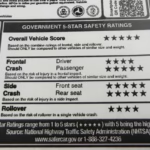
The National Highway Traffic and Safety Administration (NHTSA) tests a number of new vehicles every year and issues star ratings based on the results. This information is easily found in the safety rating section of the window sticker. Occasionally, the Insurance Institute for Highway Safety (IIHS) scores are also displayed on the window sticker, though not in our example using the Carnival. Because the NHTSA and the IIHS don’t test every car on the market, or sometimes take a while to get to a less popular model, the safety rating section may occasionally be blank. If that’s the case, a good alternative can be to check the IIHS website. You’ll also have access to added safety-related information, such as the effectiveness of a vehicle’s advanced driver aids (like automatic emergency braking with pedestrian detection) and ratings for the efficacy of its headlights.
Vehicle manufacturing is often a global process. In some cases, the engine production, transmission build and final assembly of the vehicle take place in different countries. The parts content section lists where the vehicle was assembled and often the percentage of U.S. and Canadian parts it contains. Our sample window sticker shows that the vast majority of the Carnival (roughly 90%) was sourced from South Korea.